Artificial intelligence is no longer a technology of the future. Ukrainian teachers use it to prepare materials, students use it for learning and completing assignments, and the state sees AI as one of the directions for education development.
But the key question today is no longer “should we use AI?” It is “how can we integrate it so that it genuinely improves learning?”
According to a 2025 survey of 4,689 Ukrainian educators, 70.4% use AI periodically, 10.1% use it weekly, and 7.2% use it daily. In total, 87.7% of respondents already have experience with AI tools. At the same time, the study is not representative of all Ukrainian teachers, so it should be viewed as an indicator of a broader trend.
ChatGPT, Gemini and Canva AI are the most common tools, used mainly to prepare materials and assignments and to streamline everyday work.
There is, however, an important nuance: widespread use of AI does not yet mean systematic integration into learning. For example, 43.9% of surveyed teachers do not use AI for personalised learning at all, while only 4.6% say they use it clearly and systematically for this purpose.
The technology is already here. The next challenge is learning how to use it properly.
This is one of the main issues being discussed around the world. If a student asks AI to solve a problem and receives the correct answer, it does not mean they have learned how to solve it.
The OECD’s Digital Education Outlook 2026 emphasises that ordinary GenAI tools can improve task performance without necessarily improving learning itself. If AI takes over most of the thinking, a student may perform better while working with it but struggle more when working independently.
That is why promising educational AI solutions should work differently:
Good educational AI does not do the work for a student. It helps the student learn to do it independently.
Over the next few years, we will likely see several important changes.
Systems will be better able to identify what a student already knows, where they make mistakes and what they need to revise.
If AI can easily complete a standard exercise, tasks that require explanation, argumentation, error analysis and an original solution will become more important.
Not just a grade such as “8”, but information about knowledge gaps, common mistakes, progress and learning pace.
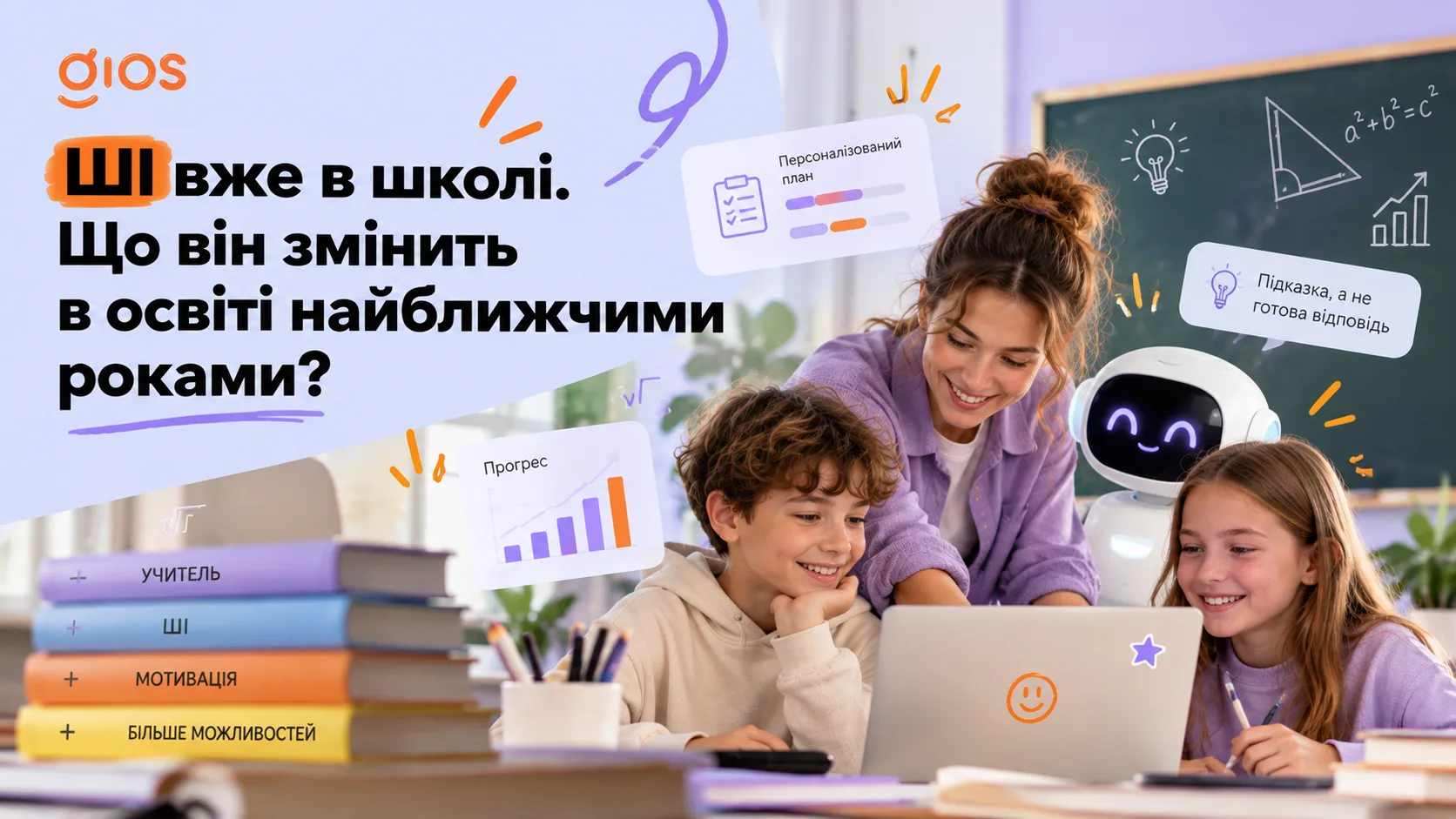
AI can take over part of the routine — preparing materials, analysing results and generating recommendations. This leaves teachers more time for explanation, support, motivation and meaningful interaction with students.
At the same time, schools will need their own rules for using AI: how to verify information, where the line between assistance and cheating lies, how to protect data and how to assess student work.
In the draft Strategy for the Development of Artificial Intelligence through 2030, education is identified as one of the priority areas. Proposed changes include developing AI skills, personalised learning, integrating AI into digital education platforms and training teachers. Importantly, this is still a draft strategy, not a finally approved document.
Meanwhile, programmes for educators and studies of how AI can complement teachers’ work are already under way in Ukraine. For example, the WINWIN EdTech Center of Excellence and UCL are researching teacher–AI interaction in Ukrainian education.
Mathematics is one of the subjects where personalisation can have a particularly strong impact.
A student may solve a problem incorrectly not because they “do not know mathematics”, but because of a specific gap: they did not understand a rule, confuse an algorithm or struggle with a previous topic.
AI and learning analytics can help identify the difference and suggest exactly the next step that a student needs.
We are preparing a new AI-based product designed to make teaching and learning mathematics at school much easier.
Its purpose is not to replace the teacher with another chatbot.
We want to combine AI, personalisation, learning analytics and pedagogical expertise to reduce teachers’ routine workload, see each student’s progress more clearly and make mathematics learning more individualised.
AI has already entered education. The question is whether we will use it simply to make old education faster, or use it to change the very approach to learning.
At GIOS, we see the future in the second option.
Teacher + data + personalisation + AI + quality content — this combination can make learning more effective and teachers’ work more meaningful.