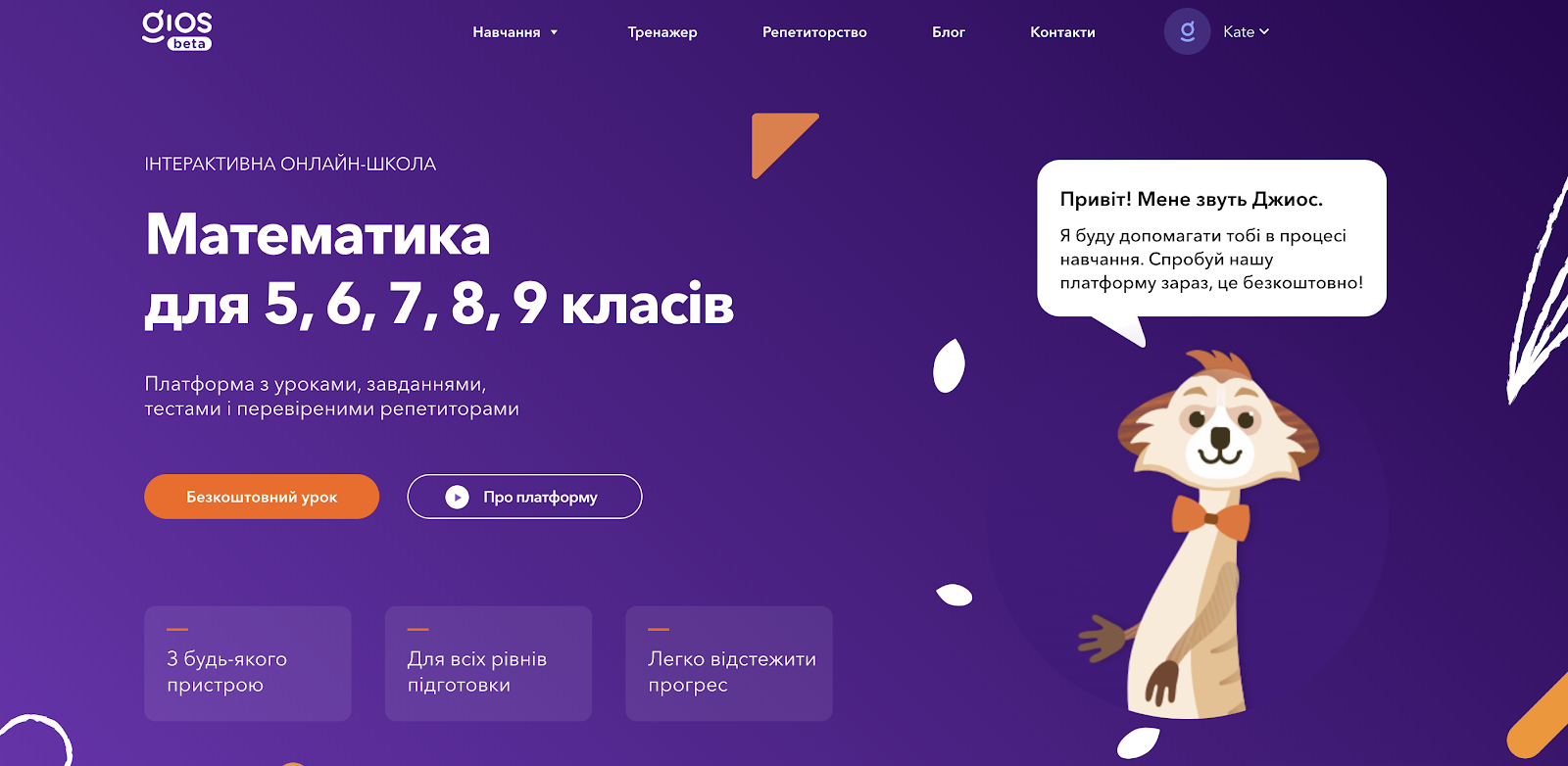
GIOS is an interactive online platform with lessons, assignments, and tests that helps organize blended and online learning and is endorsed by the Ministry of Education and Science of Ukraine.
We believe online and blended learning are ideal tools for:
Providing the whole world with modern content
Developing critical thinking (conscious choice)
Engaging children in the learning process
To meet this challenge, our team created the unique interactive GIOS online platform with animated videos, gamification, and tests, and engaged highly qualified teachers.
What makes us unique:
A comprehensive systematic approach and the full school mathematics curriculum
Endorsement by the Ministry of Education and Science of Ukraine
Unique technologies for every participant in the process
Value proposition
Our interactive mathematics platform is designed for hromadas that understand the importance of preparing high-quality local professionals and want to overcome a shortage of qualified staff caused by insufficient mathematics education.
Our solution:
Clearly demonstrates the difference
Available anywhere with a device and internet connection
Helps students quickly master practical material
Includes gamification, rewards, and motivation systems
Optimizes teachers’ time spent preparing lessons and checking assignments
Provides transparent statistics for parents and school administrators
Teachers-methodologists have transformed the current school curriculum for grades 5–9 into interactive lessons with animated video explanations, reference notes and diagrams, interactive tests, and practical assignments.
“Interactive” video with questions
Reference diagrams
Solved standard problems
Multiple-choice tasks
Matching tasks
Error-finding tasks
Sequencing tasks
Answer-entry tasks
A block of applied problems
Teachers (or principals) receive access to statistics, track the learning progress of each student and class as a whole, and compare achievement rankings.
Advantages over existing solutions
More varied learning formats
Consideration of students’ individual ways of perceiving information
Development of students’ ability to build their own educational pathway