
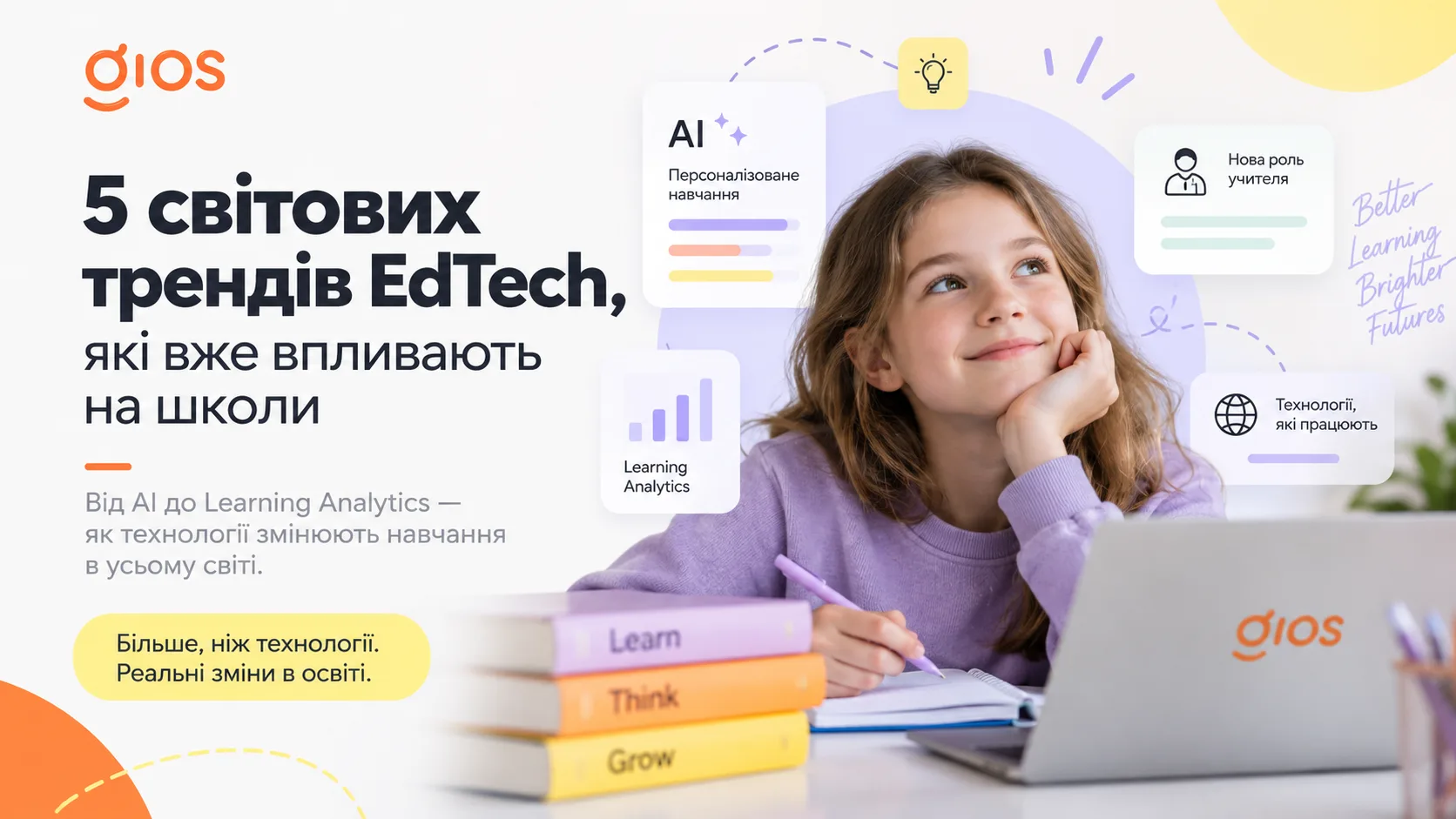
A few years ago, school digitalisation often meant an electronic gradebook, a presentation instead of a blackboard, or a textbook in PDF format.
Today, that is no longer enough.
EdTech is gradually changing not only individual tools but the very logic of learning: how students acquire knowledge, how teachers understand their progress, and how schools make decisions.
Here are five trends that are already shaping schools around the world.
Until recently, conversations about AI in education largely revolved around ChatGPT: writing text, creating tests, or explaining a difficult topic. Now the focus is shifting.
AI is increasingly being integrated directly into learning systems: it helps adapt tasks, explain material, provide feedback, and support teachers.
The OECD’s Digital Education Outlook 2026 emphasises that GenAI is already changing education not only through individual tools, but more broadly — from learning to the management of educational processes.
But there is an important nuance: AI does not make learning more effective automatically.
OECD research shows that digital technologies can increase engagement and personalise learning, but the outcome depends on instructional design and the teacher’s role.
So the key question for a school is no longer: “Should we use AI?”
It is: “What learning problem can AI help us solve?”
A class may have 30 students, but there are 30 different learning paces. One child has already understood the topic. Another needs three more explanations. A third has a gap from an earlier grade. The traditional model often forces everyone to move at the same pace.
EdTech makes it possible to change this logic. Digital platforms can analyse a student’s progress and offer tasks suited to their level.
This is personalised learning: education that takes the individual needs of each student into account. Importantly, personalisation does not mean “a separate textbook for every child”. It means the ability to learn at a different pace, receive extra practice, or get an explanation exactly where it is needed.
A grade of 7 tells a teacher about the result. But it says almost nothing about why the student received that grade.
Learning Analytics makes it possible to see more:
Schools are therefore gradually moving from “We think students did not understand the topic”
to “We can see exactly where the problem occurred.”
This trend is especially important for school leaders: data can support decisions based not on individual grades or reports, but on a real picture of learning.
At GIOS, this approach is implemented through analytics of progress, performance, activity, learning time, and test results. We described Learning Analytics and a practical GIOS case in a separate article.
One of the most common myths about EdTech is: “If AI appears, teachers will no longer be needed.”
Global approaches to AI in education are moving in the opposite direction. UNESCO explicitly emphasises that teachers are irreplaceable: AI cannot reproduce a human understanding of a student’s emotions or social interaction. At the same time, educators need new competencies to use AI effectively and ethically.
Technology can take on part of the routine: checking → analysis → recommendations → preparing materials.
This gives teachers more time for what is difficult to automate: explaining, supporting, motivating, and noticing changes in a child.
So the future model is not Teacher vs Technology.
It is: Teacher + Technology.
This may be the most important trend. Until recently, simply using a digital tool could be seen as a sign of innovation. Today, that is not enough.
Schools want to understand:
The OECD also emphasises that the effectiveness of digital technologies is not guaranteed simply by using them. Strategic integration, teacher preparation, and evaluation of results all matter.
EdTech is therefore moving from the logic of “We have a technology”
to “We have a problem → here is the solution → here is the result.” And that is good news for schools.
Ukraine cannot wait until these trends become the “new normal”. War, learning losses, child migration, teacher shortages, and unequal access to education make digital tools more than a question of innovation. They are becoming an instrument of system resilience.
But it is important not to repeat one mistake: digitalising old processes without changing the underlying logic of learning. A strong digital school is not the one with the most platforms.
It is a school where technology helps:
Global EdTech trends are not theory for GIOS. The platform already uses some of them in everyday learning.
For teachers, digital tools mean less routine work and more opportunities to focus on what cannot be automated — working with children.
According to GIOS data, using the platform helps improve students’ academic results by an average of 43% through personalised learning, continuous feedback, and the use of learning analytics.
Today, GIOS is used by more than 180,000 students, 1,000 teachers, and 200 schools. The platform contains more than 12,000 interactive tasks that make it possible not only to teach, but also to collect data about the learning process.
This is how EdTech moves from being a standalone digital tool to becoming part of a modern educational ecosystem.