How can a child continue learning mathematics after moving to another country and entering a new education system? GIOS helps maintain continuity through learning content adapted to national standards, bilingual learning and interactive practice.
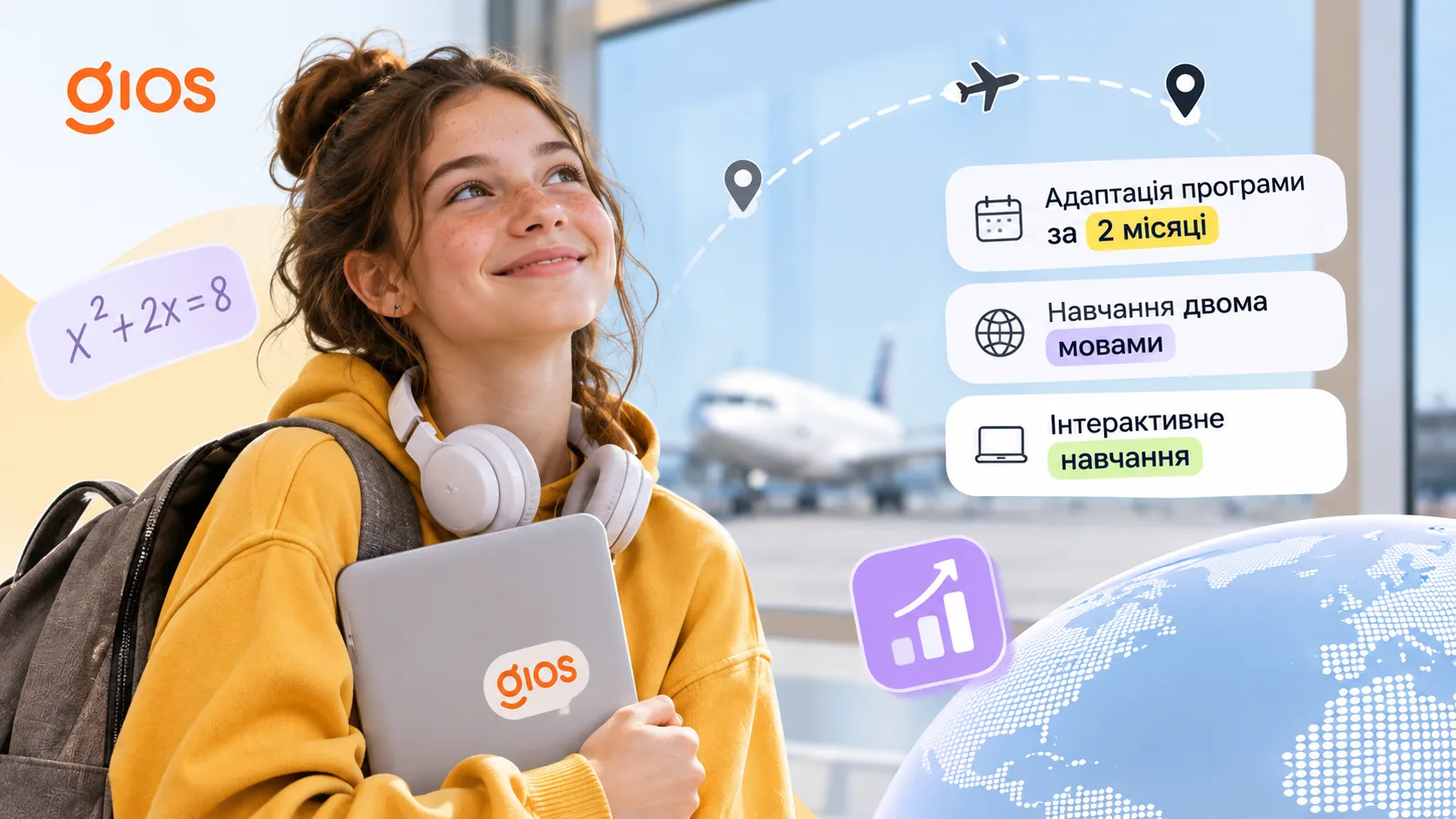
Moving abroad changes more than a child’s place of residence. The language of instruction, school environment, order of topics and expectations all change. Even familiar mathematics can become challenging when a new school uses different terminology or teaches topics in a different sequence. A student may know fractions, percentages or equations, yet spend extra time adjusting to a new system instead of learning new concepts.
GIOS (Global Innovative Online School) enables students to continue studying mathematics wherever they live. The platform combines learning materials, interactive practice, assessment and analytics, and its content can be adapted to other countries’ education standards.
Transitioning to a different education system can be difficult even for students with strong results. The challenges most often relate to three factors:
That is why simply translating a textbook is not enough. Continuity requires taking the curriculum, topic sequence and expectations of the new education system into account.
GIOS combines short video explanations, study notes, interactive tasks, hints and final tests. Students can learn independently, revisit challenging topics and track their results. Teachers receive analytics across theory, practice and testing, helping them identify where students struggle and which topics need more attention.
According to GIOS metrics:
Results depend on students’ starting level, age, regularity of lessons and how the platform is used. For teachers, this means less time spent checking work manually and more opportunity to address each student’s learning needs.
One of GIOS’s key capabilities is adapting learning content to other countries’ education standards. The platform is fully aligned with Ukrainian education standards, including the New Ukrainian School (NUS) requirements. It covers the school mathematics curriculum, with algebra and geometry taught as separate subjects for students in Grades 7–9.
For international partners, GIOS can translate and adapt the platform’s full learning content to another country’s national curriculum in approximately two months. The work goes beyond translation: the team considers curriculum structure and topic sequence, mathematical terminology, students’ ages, practical tasks and assessment approaches.
The scope and timeline are agreed individually based on the language, number of courses, curriculum specifics and partner requirements. This lets schools, education institutions and international organisations use a ready-made digital platform adapted to local requirements instead of building a solution from scratch.
After moving, students often need to learn a new language while continuing their school subjects. In mathematics, they need to understand both the concepts and the terminology used to explain them. GIOS offers a bilingual approach: students can work with learning materials in their native language and in English.
This preserves access to clear explanations, helps students consolidate their mathematics knowledge and gradually learn subject-specific terminology in English. They can continue learning without having to work through a new mathematical topic and unfamiliar language structures at the same time.
The platform’s learning cycle has three stages: theory, practice and assessment.
After completing a topic, students and teachers can review learning progress and decide what to work on next.
Changing countries or schools should not mean starting mathematics from scratch. Students need materials that match their new curriculum, clear explanations and a way to see what they have already learned.
GIOS supports different participants in the learning process:
Mathematics should remain accessible wherever a child continues their education. GIOS adapts learning content to students’ needs and the requirements of different education systems.